


Attività recenti

Gorgeous, Jim. No uglys for the Dude, I hope, in your garden. I was so happy when it cooled off here. Finally, we left the 90sF behind, but it really wrecked the blooming of many roses. The Dude did well, though, and doesn't let heat bother him. Now, it's so pleasant with highs in the 70s-80s. More like Pennsylvania--ha. Anyway, Double Easy Orange started blooming around the first week in May, tied for first with Eglantyne this year, which was different. Both those roses never quit blooming, but the Dude had lots more blooms than Eglantyne. So, that's four months straight so far. What a rose. Nanadoll

Jim,
I think you have the potential for one more flush this season. Your bush is looking great, nice and healthy.
Moses.

ElfRosa,
This is a delicate question, but needs to be said. How are you financing your renovation, which progress that you have made gladdens my heart? How can we (III), your fellow Roses Forum friends help?
Moses.

@Moses, Pitt PA, cold W & hot-humid S, z6 that's very thoughtful, thank you! So far the cost is minimal since it's mostly been water hauling, but since that is not sustainable or practical, I do have some thoughts about what could be done long term. But for now I'm going to wait until spring to see if it's even possible to get these roses properly hydrated over winter and looking normal again.
There is also community, tourist, and historical interest and there might be funds or fundraising abilities there, I don't know. I've been focusing on keeping the plants watered and alive but once the rains take over I'll start asking those questions!
In a matter of no time at all there will be Triple Pink Knock Outs. Then perhaps, white, yellow, and possibly a climbing version. Knock Outs are here to stay. More power to them. They have their niche. At Will's age, God bless him!
Moses.

I will plant some for landscaping reason. I lost many landscaping roses to voles damage in the old garden. I need some KOs to fill the color in my new front garden that has many DA roses. DA roses repeat very slow.

Nice! I may give that one a try.... :-)
When I think of the knowledge contained in the brain only, not recorded anywhere, just retained in the mind of a brilliant person in any subject, an individual being beyond expert in their field, that dies with them when their body dies, it boggles my mind.
Moses.

Susan Irvine rose books are wonderful too. Australia has more in common with my area than the British Isles. The Gwen Fagan book is so romantic too.
Gwen Fagan was, in many ways, like a modern Constance Spry (whose book, Favorite Flowers, is magnificent!) a renaissance woman. Highly accomplished, marvelously creative and a delight to read.
Every year is different for no apparent reason at all. What we do know and have control over in some cases are: excessive heat (no control over), not enough rainfall/supplemental watering, and insect and/or fungus damage will take their toll.
Make sure you are generous in your natural soil amenities: compost, aged manure, alfalfa pellets, etc., applied every year, in addition to conventional fertilizers. Check your pH. Ideally, it should be slightly acidic at ~6.5 - 6.7pH. Adjust it accordingly if/as needed.
My fall flush last year was great.....this year almost a bust is expected. I know why so this year. They are the saw flies. Left unsprayed this year......I am paying the price. Next year I will be prepared for them.
Moses.
Rifis,
You said a mouthful! What a relief not to contend with the dreaded Rose Midge Fly anymore. This season, 2026, is the 2nd. year now. What was the worst part of Rose Midge Fly was that no matter how carefully and faithfully the roses were sprayed, there was 5-7% new damage that showed up at the next, every two week, spray session, so the midge kept on reproducing and kept on reinfesting, although greatly controlled.
You know, Rifis, since I stopped spraying a systemic insecticide, imidacloprid, for midge, the dramatic increase in damage of what I assume is the work of saw fly larvae, caterpillars, has become severe. They are not the destruction of mature leaves through chewing myriads of holes, and when tiny, just hatched caterpillars, making lace-work of mature leaves, but the damage of small leaves at growing tips, not the green developing flower buds, just the leaves only. The damage, although not really to the developing, green flower bud, weakens tiihe tip so that the resulting flower is usually undersized.
I will definatively have to commence spraying next year, 2027. However, a resumption of the level of intensive spraying as was required for Rose Midge Fly control is not expected. As you know, though, with roses.....expect the unexpected. I'm going to take a positive attitude, come what may.
I intend to begin spraying right away to help make a dent in the population and reduce the amount of over-wintering nymphs or eggs.
Another thing, I do not know for sure if the caterpillar is in fact a saw fly larvae! I have almost none of the typical saw fly larvae leaf lacing in my garden. My larval insects and photos of saw fly larvae look identical. I thought perhap that my caterpillars were the larvae of the cabbage butterfly which is commonly seen fluttering about here. Photo comparisons of both larvae look the same to me. When I find a caterpillar on a rose growing tip leaf (very hard to do), it almost always is a solitary caterpillar. Questions, questions.....
Moses.
Mike,
Please take note of what Rifis wrote above. Your sudden onslaught of symptoms may well be Rose Midge Fly damage.
Where do you live, approximately.....largest nearby city? What is your agricultural zone? Do you have any local expert to consult?
Moses.
Ler me explain. Just as I was reading through Mike’s opening post, I spotted Moses’ name in bold immediately below, and I ”knew” he was going to bring up midge. Then, when I saw he did not, I thought I missed something. I mentioned the ”good news”, as Moses has deep experience with this insect. Later, bugged by what I had been thinking, I asked the google search box about it, and that’s what it replied.
My garden is not doing well this year due to rain, heat plus midge. Will plant some landscaping roses next year for easy care & quick colors.
Straw,
My rose garden's soil is ~2' deep of black, loamy topsoil, no clay in it. It took a lot of blood, sweat, and tears to gret it that way. If it had clay in it, it would be toned down from black to tan because my native clay is yellow, almost golden in color. Below the soil is a dense, cement like layer of yellow clay going down considerably, 10+' in places before it hits rock.
You sure have had major challenges to grow roses, Straw. That trench digger got a good workout. I'm sure it has paid for itself many times over going by the outstanding results you have achieved.
Your roses are grown to perfection. When I see a photo of yours of a variety I also grow I realize that I have to raise my standard to meet yours. Keep inspiring me.
Moses.

@jim1961 Central Pennsylvania Zone 6a
Agree that all gardens are different due to different soil & climate. I grew 2 dozen roses grafted on Dr.Huey back in 1997, and NONE had rust since it was fast draining loamy soil. But this previous garden had acidic soil with blue hydrangeas, so roses had bad blackspots and all those grafted-roses died through 2000 record snow, except for Queen Elizabeth. That garden was 40 min. away from my current garden.
In 2001, I moved to my current garden of POOR DRAINAGE alkaline heavy clay. In 2012 we had lots of heavy rain, and ALL the neighbors' roses (grafted on Dr.Huey) BROKE OUT IN RUST. That's the first time in my life that I saw rust.
Thank God I got into own root roses in 2011 and NONE of my roses got rust during 2012 heavy rains. Own root roses can handle tons of acidic rain better than Dr.Huey-rootstock.
My own root Angel Face was 100% clean, while the neighbor's Angel Face (grafted on Dr.Huey) was full of rust, and she got rid of it.
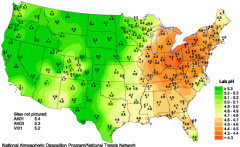
Below is a map of rain, showing rain is more acidic at pH 4.5 in my NW Chicago, versus less acidic in the West Coast (California) at pH 5.6.
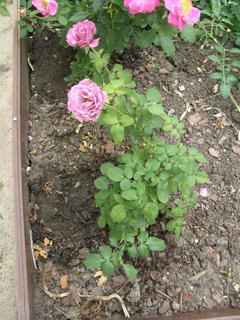
Below was my OWN ROOT Angel Face, it was very healthy. But it died after 2 winters due to poor drainage clay. That's before I bought the 5 feet long trench digger to dig for drainage:
Below was a bouquet with Angel Face on top, white Borelo, and red Pink Peace. They were mulched with horse manure at pH 8 (stable here used agricultural lime for their stall, which UP the pH of the horse manure):

My garden differs even from one year to another. Last year I had lots of dill & cilantro in my garden and zero thrips. Cilantro and dill plants host beneficial insects like praying mantis, green lacewings, and lady bugs which devour thrips. This year I got rid of my dill and regret it, with my backyard's roses having thrips, but the front garden with tons of calendula (host beneficial insects) do not have thrips on roses in front.
I will be planting dill today since I like it in my salad.
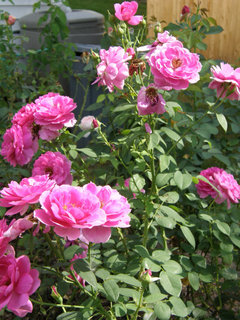
I once planted my 2nd Wise Portia in an air-pot with bagged dense clay. It won't drain fast enough in heavy rain, and Wise Portia had the worst rose slug infestation. So I moved Wise Portia in a raised bed (after I broke up the soil with tons of pelletized lime for fast drainage). Wise Portia has zero rose slugs ever since, and NOT much blackspots even in month-long humidity at above 80%, pic. taken in August:
Nice Roses Straw! Same here so many variables season to season! lol
Some roses do well know matter what's thrown at them other roses not so much...lol
Just enjoy... :-)

Dianela,
I agree with Susan. It could be Sheer Bliss or Francis Meilland.
It looks like Francis Meilland to me. Everything checks out. Although FM is an ADR winner, the fact that your specimen there has foliage with a considerable amount of black spot is understandable considering it appears to not be getting the best care. See how those heavily spotted leaves are still green and hanging on? It's a black spot fighter indeed. Francis Meilland came out in 2009 in the USA, so its relative newness means whoever planted the bush more than likely had easier access to it commercially, than to Sheer Bliss.
Whereas Susan's thoughts that it is Sheer Bliss I believe is less likely, Sheer Bliss being over fifty years old, having come out in about 1970 from J & P Roses, puts it in the heyday era of, 'spray every day,' Hybrid Teas from back then. The roses from that era were black spot magnets and by late August, now, Sheer Bliss unsprayed out your way as around here, wouldn't have much foliage left that wasn't heavily spotted, turning yellow, and falling off.
Moses.
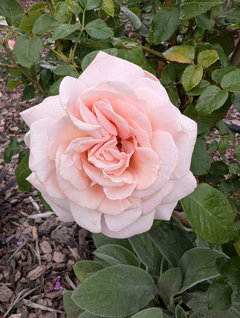
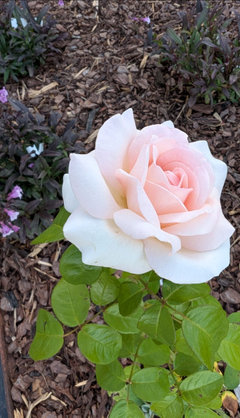
I can contribute a couple photos of my young Francis Meilland. It's a really great rose, wonderful scent, thick petals that make for long lasting blooms, healthy and vigorous.
Sorry that you have to contend with chili thrips. Your suffering reminds me of the year after year misery of having to spray religiously, every two weeks, from early May until mid-October for the dreaded rose midge fly.....a serious problem in the Northeast. I found only conventional spraying was effective.....organics failed miserably. If not faithfully sprayed, there would not be one bloom in the entire rose bed after the first flush all season long, nothing but green leaves, no flowers.
Suddenly, without any tapering off, with the spring of 2025 season things starting as usual....I began spraying preventatively in mid-May, but it soon become apparent that there was no midge damage occurring (even with spraying about 5-8% damage was always seen....an acceptable level), nowhere to be seen. I stopped spraying, and sure enough, not a speck of rose midge fly damage anywhere. It's been totally clean this year too. Amazing! It has to be Divine intervention, because such a switch is unheard of locally.
Back to your dilemma.....can you spray with a conventional systemic, or with a soil drench for chili thrips?
Moses.
Chili thrips can't survive my cold winter at -20 F below zero, and other species of thrips are lessened by my cold weather.
Green Lacewings and Lady bugs are predators to reduce thrips. Green lacewings are attracted to plants such as dill, fennel, cilantro, goldenrod, yarrow.
Lady bugs are attracted to dill, marigold, yarrow, sweet alyssum, calendula, purple cone flower,
I didn't have thrips in the years which I planted lots of dill & marigold, sweet alyssum in my back garden.
Before 2005, my garden had tons of yarrow (very invasive), we had lots of lady bugs back then and I never saw any thrips back then.
This year I have lots of calendula & purple cone flower in the front garden, and I don't see the regular thrips there, but I see regular thrips in my back garden.
Next year I will plant more sweet alyssum to attract lady bugs. Also dill to attract green lacewings (aphids lions). Never have any aphids with dill planted between roses. Below is sweet alyssum in my garden:


Below is yellow Calendula in my garden, lots of ladybugs in my front garden to wipe out the regular thrips:


I only have the western flower thrips, not chili thrips, but I also have had a lot of success with using beneficial insects. I got mine from DMV Beneficials. They are more affordable than some of the other places and they offer free consultations. I got minute pirate bugs, lacewing larvae, and predatory mites to cover the already living thrips on the foliage, and beneficial nematodes for the surrounding soil for longer term predation on the thrips that hatched later. It worked wonderfully. I got away with just one application of all of them and haven't had trouble since I released them this spring.
True Gratitude bloomed with the richest colored bloom, just one, undersized bloom, but much appreciated. Foliage looks pristine and would show black spot damage even though recently planted because this has been a brutal year for black spot. One of my four Apricot Candys is totally defoliated now. The decision to replace all four has been a hard pill to swallow, but in order to have a fungicide spray-free rose bed, I have no choice.
Their replacements planned so far are:
1. Brindabella Dawn
2. Julie Andrews
3. True Bloom True Serenity
4. " " Sincerity
The dominant color of Apricot will really be broken up by this diverse color group, in the stretch of bed the Apricot Candys inhabited being pretty much adjacent to one another.
Moses.
My True Gratitude has been in the ground for about 3 weeks now. A number of blooms have cycled and a few preliminary observations I can safely make are:
1. The bloom color is impressively vibrant. Is it purple? No, too much leaning toward red in there. Is it Mauve? No. HMFR describes it as fuchsia/magenta, I think they nailed it. It's hard to believe that its bloom size will 5.5" across as HMFR has stated. That's a big rose! The first blooms here are quite small, understandably so.
2. Not a speck of black spot so far. I hope it stays that way.
3. The canes do no arch. That's a good sign for my purpose of growing True Gratitude as a stand alone bush jnstead of as a climber. Its stated height of 6', if true, would work in my favor.
You know, my one and only 8' X 18' rose bed is being overrun with Ping Lim's True Bloom line of roses. So far they are: True Gratitude (new), True Inspiration, True Sincerity, True Serenity (new), True Passion, True Love, True Spirit, and True Devotion (possible shovel pruner). That's eight (8), bushes!
My Sweet Fragrance bushes, another older Lim rose, were black spotters, unfortunately, but boy, could they bloom. No garden should be without this rose if black spot is not an issue. Sweet Fragrance blooms with reckless abandon, first to start in spring, and last to finish in the autumn. I did not find the blooms more than just moderately fragrant, though. I miss them terribly, but in my goal of having as spray free a garden as possible, I have to keep in line with the program.
Moses.

I’m very sorry to hear that, Sheila. I knew she was fighting cancer but was hoping she would be ok. What a tragedy for her husband and children!

Same Sheila, terribly sorry to hear that. Heirloom was the first company I ever bought a rose from and has always been my go to. I will be praying for him and hope to keep supporting their business in the future.
Moses Madame Anissette is a beast 🥰in the best way. I love plants that tough.
Blooms and foliage, perfection! In my heat and Ben’s old texas I think it shuts down blooming for most if the summer, but otherwise perfect.
Good advice. Do what Nollie advises.
Moses.
I noticed at our local hospital the KO's and other plants planted near tree roots are growing poorly... Good Luck Kelly hope you figure things out!

Windowsill,
What a nice treat....I visited the Peggy Rockefeller Rose Garden last week, and today, on my birthday, I am gifted with a visit to the Crawford Rose Garden....all made possible through your kind generosity.
Do you know if the roses at the CRG are dead headed or not? It looks like they might not be.
Sheila,
Is that what that enormous perennial is, a plume poppy? I thought it was possibly an acanthus or a hollyhock relative having unique foliage structure that forgot to stop growing!
Moses.
Thank you, Windowsill, Vapor and Judi. I did have a happy birthday....not too much activity.....just on the phone more than usual, though.
It almost got to 90°F., and factoring in the ~6 degree increase due to my heat trap, it was oppressively hot, but the roses trudged through. With 7 inches of rain over the last two weeks, I haven't had to drag the hose around.
Window,
Julie Andrews came through in pretty good shape for this time of year, but with no blooms nor buds. It was pruned moderately hard by the grower, possibly in anticipation of autumn? Or, it had gotten so lanky and rough looking over the summer months that in order to, 'hide the evidence,' the grower resorted to extreme measures.
Whatever the case, my Julie Andrews is not in bad shape at all, just not in the fresh, lush condition one expects from April/May mail-ordered, container grown roses. She and her three fellow replacements (True Sincerity, True Serenity, and Brindabella Dawn), for my four (4), Apricot Candys, are scheduled to make the move in the next couple days.
I will dearly miss the abundance of bloom the Apricot Candy bushes produced with reckless abandon, but not their black spotted foliage/defoliation. In my campaign to no longer have to spray for black spot with the AC's removal/replacement, I believe I will have reached my goal. However, if I want to effectively control the ravages of saw fly, especially at growing tips (although developing flower buds at the tips are usually not caterpillar eaten, just the adjacent developing foliage), I must spray an insecticide regularly, so my sprayer cannot really be reetired, try as I have to mothball it.
Moses.

@strawchicago z5, Thanks. It's in zone 7b. I have to say the Kashmir shrubs were really shapely and densely covered with leaves all the way down to the bottom. They had a very nice looking Sweet Spirit, as well. Jude had a great fruity scent!
Is nobody going to mention the cute bunny beneath Flower Carpet Amber? :-)

Coriacious from Massachusetts in commenting on Easter Basket at HMFR, reported in 2012, that Easter Basket was (in 2010), given the highest performance rating of any repeat blooming rose at the PRRG.
Easter Basket is a much under advertised rose. The old saying, 'The horse that earns its oats doesn't get them,' really applies to Easter Basket. This Meilland rose was never awarded an ADR. Perhaps it was never submitted for trial by Meilland, or it was submitted and for some reason or another, failed the trial?
Moses.
Please note. I you are interested in growing True Bloom True Inspiration, do not be misled by the growth habit it shows growing in the commonly seen 2 gallon logo pots. With its blooms arranged in a broad presentation in said pots, one would be inclined to assume it is a spreading bush. My experience, and looking at the photo Windowsill Gardener provided, you can see T.B. True Inspiration is vertical in its growth habit, not rigidly so, but not spreading.
Moses.
@windowsill_gardener I appreciate your pics. very much, it helps to decide what roses are best for my zone 5. What planting zone is New York Botanical Garden's Peggy Rockefeller Rose Garde? Thank you.
@strawchicago z5, Thanks, it's in zone 7b.


@Vaporvac Z6-OhioRiverValley, The only place I could put Rosanna would be next to Laguna!
Thank you all for the input. Seems like the best move is to leave Laguna where it is. Now I just have to figure out what to plant in place of my underperforming Kiss Me Kate. lol! But… I don’t have room for a monster there.
Markay,
Both Tangerine Skies and Rosanna are beautiful roses. My preference is Tangerine Skies.
It's flower form, leaning to hybrid tea appeals to me more than Rosanna's English rose bloom form. The color of TG is appealing to me. Its uniqueness places it into its own class. Reports on its disease resistance, although TG and Rosanna are not ADR winners, are favorable.
Moses.
Bill,
There's no perfect irrigation system for flower beds, which are much harder to find a successful method for than are lawns. The Hunter brand has a top reputation, but any permanently installed system in a flower bed, which has a dynamics of, 'what was good today is not so good over the years because we: move plants, they grow larger, they die and need to be replaced, etc......' Flower beds are always changing. You need an automatic irrigation system that changes with these dynamics.
I would look into the 'next generation,' soaker hoses. They are inexpensive compared to an installed system, can be laid out and moved at will to meet changing needs, and when covered with mulch they are unobtrusive.
The trouble with the sprayer head installed system is that foliage gets sprayed, which unless you are growing roses that have superior, excellent, and proven to be so, black spot resistance, regularly moistened leaves become a disease nightmare. Grow only A.R.T.S., A.G.R.S., or A.D.R. awarded through rigorous trial roses, and an installed watering system will do fine from the standpoint of rose diseases.
Bill Rader of Knock Out fame, developed his black spot/general fungus resistant roses by grinding up diseased rose foliage and spreading it through all his seedling roses. Those that throve went on to the next steps in his trial program.
Encouraging rose disease with regularly drenching their foliage wiyh water using a sprinkler system is not advised.
Moses.

Because all other roses will do the same. Unless we all are planting R. Palustris, R. Roxburghii and or R. Spinosissima the roses will continue to get RRD.
The Multifloras are the main spreader but those things are indestructible. They flower while having RRD and set seeds, the plant withers away and it's offspring are in a perpetual system lol
When can we have RRD immune roses by genetic modification? I feel like that would be a game changer for many...

Beautiful in all stages of bloom.....not many roses can make this claim.
Moses.
February is usually when we get our bareroot stock in at Lowes.
That said however, if I had to take a guess it's probably a regional though with timing.
Yes, a zone 4 person said her Lowe's stocked bare root in March 20 with a special sale.
Moses, I tried to take a pic, but not sure how well you’ll be able to see the structure of it through all the healthy foliage.
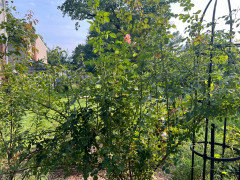
Thank you, Markay. I see that Peach Melba is a big boy, indeed! It needs room, and plenty of it.
I hope your Peach Melba exceeds your expectations!
Moses.


I definitely give matt Perhaps give him a call the next time. I found he's really easy to talk to and happy to answer questions over the phone. As are The others folks that work there. Sometimes that's easier and quicker for both parties.
Markay,
I have three Dee-Lish bushes which I like very much. Of all my tall HTs, it is the best all around to date: quite good disease resistance to black spot, the most winter hardy, quick repeat, longest lasting blooms, and most fragrant. Dee-Lish beats out my: Princess Charlene de Monaco (lanky to a fault), Quick Silver (not succeeding making a tall bush out of it....continues to grow long octopus arms, even at dead head cuts), and Moonlight Romantica (stingy, small, blah blooms), the two new tall HT candidates: Madame Anisette and True Gratitude, look very promising.
Why I started with Dee-Lish in responding to you inquiry about Sweet Mademoiselle is that they both have the Austin rose Graham Thomas in their pedigree. Their commonality may mean that Sweet Mademoiselle is as strongly black spot resistant as Dee-Lish is, but she has not received an ADR. This may be because she failed the ADR trial, or wasn't submitted because failure was expected because less than ideal fungus resistant traits were already observed in Meilland's own growing fields.
I did purchase an own root Sweet Mademoiselle some years ago, but did not plant it because it appeared to me to have a crown gall. If I had received and planted a healthy one back then, I would know its strengths and weaknesses by now. I would only try a Sweet Mademoiselle again if I had two separate highly favorable reports on superior black spot resistance and winter hardiness to the tips, from gardeners having the same, hot humid summers and cold winters, as I have.
Many gardeners who grow Sweet Mademoiselle give her glowing reports, but not sufficiently relevant to my growing conditions.
My Apricot Candys never exceeded 36-40". My oldest bush had a crown almost a foot across. I reduced their height to 10-12" every spring pruning. I believe Sweet Mademoiselle will easily exceed 3', probably 5-6' or more.
I replaced my four (4), Apricot Candy bushes with:
True Serenity (new)
Julie Andrews (new)
Brindabella Dawn (new)
True Sincerity (have one already)
Moses.
Markay,
How tall does you Yellow Submarine get? HMFR lists it as growing 2'-3' tall. Is Yellow Submarine a good repeat bloomer? No black spotting, right? Thank you. Again, your bush looks phenomenal......inspirational!
Moses.
Moses, everything gets at least some blackspot in my garden. I went out in the fading light for a pic of Yellow Submarine as it is on this last day if August.
As you can hopefully tell, it has so spotty foliage, but it also had a whole lot of healthy foliage and it has s bunch of buds. It is a solid repeater. Mine is probably pushing 5ft now with the lanky late season growth in response to less day light hours.
The Katherine Dulin Folger Rose Garden in DC has a lovely grouping of Yellow Submarine which is how I was introduced to this rose. If you search the garden, I’m sure there are many images online.
Yellow Submarine does not nod, but the blooms do open to expose the stamens. Bees love them.